By Jonathan Seal · Research-based · Updated
As an Amazon Associate I earn from qualifying purchases. About our affiliate links.
The short answer
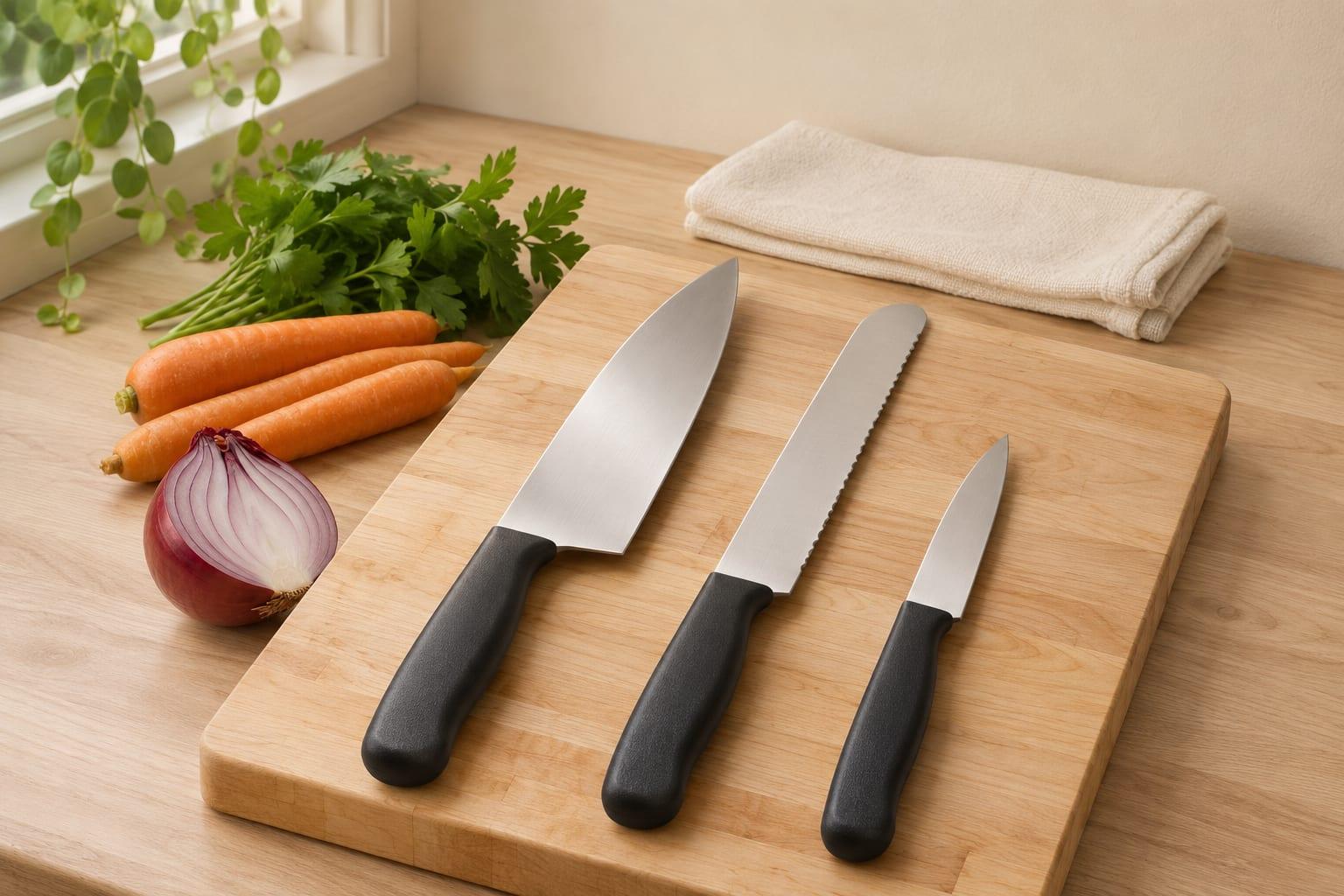
Start with three knives: a chef’s knife, a bread knife and a paring knife. America’s Test Kitchen calls them the big three, and says that with only those you’ll be well equipped for everyday cooking. The set we’d buy is the Victorinox Fibrox 4-piece. It has all three plus a 6-inch utility knife, and it won America’s Test Kitchen’s knife set review (updated October 2026).
On a tighter budget, the Mercer Millennia 3-piece has the same three knives for less than $100. If you’d like knives made in Germany, the Wüsthof Gourmet 3-piece was $139 on Wüsthof’s own site on November 21, 2026.
| Set | What’s in it | The catch |
|---|---|---|
| Victorinox Fibrox 4-piece | Chef’s, bread, utility and paring knives | No storage, and a bulky paring knife handle |
| Mercer Millennia 3-piece | Chef’s, bread and paring knives | No storage, and it can cost less bought separately |
| Wüsthof Gourmet 3-piece | Chef’s, bread and utility knives | An 8-inch bread knife, and no paring knife |
Best starter set: Victorinox Fibrox 4-piece
Four knives, and you’d use every one: an 8-inch chef’s knife, a 10.25-inch bread knife, a 6-inch utility knife and a 4-inch paring knife. America’s Test Kitchen had already recommended these blades one by one, starting with the 8-inch chef’s knife it has favored for decades, and every blade in the set aced its testing.
The utility knife is a good extra for a new cook. It works as a smaller chef’s knife while you get used to the big one, and America’s Test Kitchen recommends it for older kids learning to cook. America’s Test Kitchen’s only quibble was the paring knife, whose slightly bulky handle suits larger hands better.
Victorinox says Fibrox knives are dishwasher safe, which forgives a lot while you’re learning, though the care notes below explain why we’d hand wash them anyway. There’s no block, so plan on blade guards or a magnetic strip.
Best on a budget: Mercer Millennia 3-piece
Just the big three: an 8-inch chef’s knife, a 10-inch bread knife and a 3.5-inch paring knife, for less than $100. America’s Test Kitchen made it the Best Buy in its set review. The bread knife is its longtime favorite, and the chef’s knife is its Best Buy chef’s knife.
Two things to know. America’s Test Kitchen found you could spend less by buying the three knives one at a time, so compare before you check out. And like the Victorinox, the paring knife has a bulky handle.
Mercer’s page for the Millennia paring knife lists Japanese steel at 53 to 54 on the Rockwell hardness scale, made in Taiwan. Steel that soft is easy to bring back to sharp and needs honing more often. Mercer is also firm about washing by hand, as the care notes below explain.
Made in Germany: Wüsthof Gourmet 3-piece
An 8-inch chef’s knife, an 8-inch bread knife and a 4.5-inch utility knife, laser-cut from Wüsthof’s own steel and made in Germany. Wüsthof calls it the Gourmet 3-Piece Starter Set, and Wüsthof’s own store had it at $139 on November 21, 2026, down from $185.
It isn’t a perfect match for the big three. The small knife is a 4.5-inch utility knife rather than a paring knife, so it’s longer than the 3 to 4 inches America’s Test Kitchen prefers for peeling in your hand. The bread knife is 8 inches, and America’s Test Kitchen prefers 10 inches or more, because shorter ones got lost in big crusty loaves in its testing. It’s fine for sandwich bread.
Buy this one if a German maker matters to you. If it doesn’t, the Victorinox is the better starter set.
If you want a block: Victorinox Fibrox 8-piece
Some people want everything in one place on the counter from day one. This is the block we’d choose: the same plain Fibrox knives in a slanted hardwood block, with a 4-inch paring knife, a 6-inch boning knife, an 8-inch chef’s knife, an 8-inch bread knife and a 10-inch slicer, plus shears and a steel.
It costs more than the starter sets. Victorinox charged $260 on its own site on November 21, 2026, and the boning knife and slicer are pieces a beginner won’t use much. Check Amazon’s price and who the seller is, because Victorinox’s warranty only covers authorized sellers.
Which knives do you need, and what size?
A chef’s knife does most of your cutting: chopping onions, slicing chicken, mincing herbs. A bread knife handles bread, tomatoes and anything with a crust or a soft skin, where a straight edge would skid or squash. A paring knife does small jobs in your hand, like peeling an apple or hulling strawberries.
Size matters more than brand when you’re starting out. After years of testing, America’s Test Kitchen prefers an 8-inch chef’s knife, which it calls the best length for most people, a bread knife of 10 inches or more, and a paring knife of 3 to 4 inches. The bread knife is where sets fall short. In its testing, 8-inch bread knives got lost in large loaves.
If an 8-inch chef’s knife feels big in your hand, a 6-inch one is the next size down, and the Victorinox set includes one. A santoku does the same job as a chef’s knife, so you don’t need both.
What you can skip for now
Most of a big block. Steak knives, a boning knife, a slicer, a second utility knife, shears and a steel make up much of a 15 or 18-piece set. Of the sets our buying guide counts, the ones with 18 or 19 pieces in the box hold 8 or 9 kitchen knives, and four of the nine in Wüsthof’s 18-piece Gourmet block are 3 inches or shorter.
America’s Test Kitchen says many sets seem designed to dazzle with the highest number of pieces at the lowest price. Josh Donald of Bernal Cutlery made the same point in that review: spend your budget on the knives that matter most, rather than lowering their quality to pay for the ones that matter least.
You can add any of the rest once you know you’ll use it. Steak knives are easy to buy later, and a boning knife only earns its place if you take apart whole chickens or roasts.
What to get with your first set
Somewhere to keep the knives. None of the three starter sets comes with storage, and loose knives in a drawer knock into everything else. Victorinox puts it plainly on its blade guard page: knives that knock against other utensils go blunt, and uncovered ones can cut your hand while you rummage. Its own site sells a 7-inch guard for $6.00. Check the length, though, because the chef’s and bread knives in these sets need longer guards. A magnetic strip on the wall or an in-drawer block works as well.
A wood or plastic cutting board. Wüsthof’s warranty doesn’t cover damage from cutting on glass, granite or stainless steel, which tells you what those surfaces do to an edge.
A honing steel or a simple sharpener can wait. A new knife arrives sharp. When it starts sliding off a tomato skin instead of biting in, it’s time.
How to look after your first knives
Wash each knife by hand and dry it straight away. That one habit does most of the work. Mercer’s care instructions for its Millennia knives explain why: wash in warm water with mild soap, rinse, dry with a soft towel, and never use a dishwasher. The heat can damage the handles, the edges dull from rubbing against each other, and harsh detergent can stain and pit the blade. Mercer also says not to soak knives for long, and to rinse off any bleach right away.
Not every maker is that strict. Victorinox says its Fibrox knives are dishwasher safe. Mercer’s point about edges rubbing applies to any knife, though, so we’d hand wash all three of these sets.
The rest is simple. Cut on wood or plastic, keep the blades covered or on a strip, and keep a good knife away from frozen food and bones, which Wüsthof’s warranty also rules out.
Common questions
Quick answers for people buying their first knives.
What knives should a beginner buy?
A chef’s knife, a bread knife and a paring knife. Those three handle nearly everything a home cook does. Add other knives once you notice a job they can’t do.
Is a 3-piece knife set enough?
For most people starting out, yes, if the three are a chef’s knife, a bread knife and a paring knife. Check the sizes too: an 8-inch chef’s knife and a bread knife of at least 8 inches, ideally 10.
Should a beginner buy a knife block set?
Only if you want steak knives or a block on the counter. Otherwise you pay for pieces you won’t use yet. If you do want one, the Victorinox Fibrox 8-piece has less filler than most.
Chef’s knife or santoku for a beginner?
They do the same job, so you only need one. America’s Test Kitchen’s winning set is built around an 8-inch chef’s knife, and that’s the one we’d start with.
What’s the best knife set overall?
For most home cooks, the same Victorinox Fibrox 4-piece. Our main guide compares it with block sets and splurge sets.
Where this comes from
Research-based, not hands-on. We read America’s Test Kitchen’s knife set review (updated October 9, 2026), Wüsthof’s, Victorinox’s and Mercer’s own product pages on November 21, 2026, including Mercer’s care instructions, plus Wüsthof’s warranty terms and the Amazon listings for these sets. You won’t see Amazon prices typed in here, because they change often and Amazon limits how sites like ours can show them, so click through for today’s price. Tell us at contact@knifesets.com if something has changed.